
Golf Cart Laws by State: Your 2025 Guide to Street‑Legal Rules
Driving a golf cart on public roads can be a convenient and fun way to get around your neighborhood or community. However, golf cart laws by state vary significantly. What’s perfectly legal in Florida might land you a ticket in California. This comprehensive guide explains the key rules for Low‑Speed Vehicles (LSVs) and Neighborhood Electric Vehicles (NEVs), covering registration, equipment, speed limits, and where you can drive. Before you head out, make sure your Evolution cart is properly set up. Visit our shop or contact us with any questions.
Understanding the Difference: Golf Carts vs. LSVs/NEVs
Before diving into state laws, it is crucial to understand the distinction between a standard golf cart and a Low‑Speed Vehicle (LSV) or Neighborhood Electric Vehicle (NEV), as they are regulated very differently.
- Golf Cart: Typically designed for use on a golf course, with a maximum speed of around 15-20 mph. They usually lack the safety equipment required for public roads.
- Low‑Speed Vehicle (LSV) / Neighborhood Electric Vehicle (NEV): These are street-legal vehicles built to federal safety standards. They can travel between 20 and 25 mph and are legally defined as motor vehicles. They must have a 17‑character VIN, be titled and registered, and be equipped with mandated safety features like headlights, turn signals, mirrors, seat belts, and a windshield.
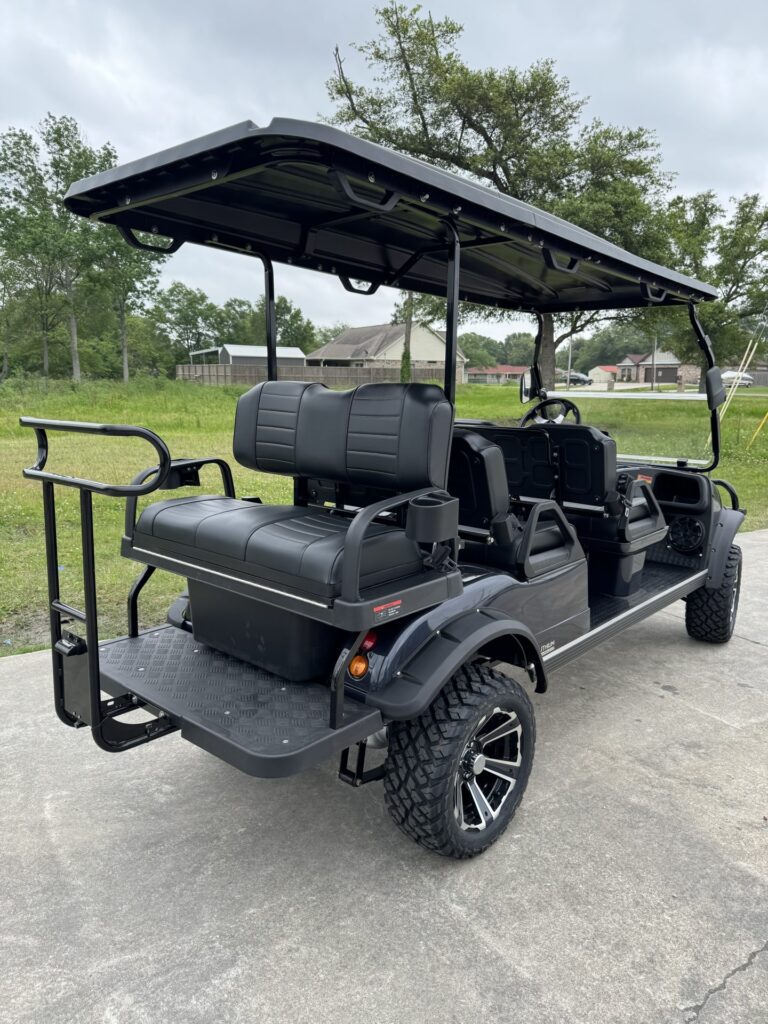
All Evolution carts are designed and built as LSVs, meaning they come factory-equipped with everything you need for road legality.
Key Considerations for Street-Legal Golf Carts
No matter which state you live in, if you plan to drive an LSV on public roads, you will almost always need to meet these general requirements:
- Registration & Titling: LSVs must be registered with your state’s DMV and display a license plate. Standard golf carts used off‑road generally do not require registration.
- Insurance: In most states, you will need liability insurance for an LSV. For standard golf carts, insurance may not be required by law, but it is strongly recommended to protect yourself financially in case of an accident.
- Driver’s License: A valid driver’s license is required in nearly every state to operate an LSV on public roads.
- Allowed Roads: LSVs are typically restricted to roads with posted speed limits of 35 mph or less. They are prohibited from highways and interstates.
State-by-State Golf Cart Laws
Here is a breakdown of street-legal laws for some of the most golf-cart-friendly states.
Florida Golf Cart Laws
Florida is a very golf cart-friendly state, but it has strict rules for street use.
- Golf Carts:
- Low-Speed Vehicles (LSVs):
Texas Golf Cart Laws
Texas permits golf carts on public roads under specific conditions.
- Golf Carts:
- LSVs/NEVs:
- These are titled and registered vehicles allowed on roads with speed limits up to 35 mph. They must meet federal safety standards.
California Golf Cart Laws
California’s laws are among the strictest in the nation.
- Golf Carts:
- LSVs (NEVs):
Arizona Golf Cart Laws
Arizona law is relatively clear about the difference between golf carts and LSVs.
- Golf Carts:
- LSVs:
South Carolina Golf Cart Laws
South Carolina’s laws have some unique provisions.
- General Requirements:
- Operational Limits:
North Carolina Golf Cart Laws
North Carolina has a growing number of LSVs on its roads, requiring strict adherence to the law.
- Golf Carts:
- LSVs:
- Must be registered with the NC DMV, insured, and equipped with all mandatory safety features (headlights, turn signals, brake lights, mirrors, seatbelts, windshield, and a VIN).
- The driver must be at least 16 years old and have a valid driver’s license.
- May only be operated on streets with a posted speed limit of 35 mph or less.
Georgia Golf Cart Laws
Georgia law offers clear guidelines for these vehicles.
- Golf Carts:
- Permitted on roads with a speed limit of 25 mph or less.
- Must have headlights, tail lamps, horns, and rearview mirrors.
- LSVs:
- Allowed on any public road with a speed limit of 35 mph or less.
- Must be built to meet federal LSV safety standards from the factory.
General Rules in Other States
- Alabama, Delaware, Oregon, and Hawaii: These states have made it flat-out illegal to drive a golf cart on public roads statewide.
- Illinois, Maryland, Nebraska, Nevada, Wisconsin, and Kansas: These states generally ban golf carts on the road but allow local municipalities to enact their own ordinances permitting them.
How Evolution Carts Are Already Street Legal
Every Evolution golf cart is designed and built as a Low‑Speed Vehicle (LSV) from the factory, not as a standard golf cart that needs costly and unreliable modifications. This means your Evolution cart already meets or exceeds the legal requirements for street use.
All Evolution carts come standard with essential LSV equipment, including:
- LED headlights, taillights, brake lights, and turn signals
- Seat belts for every passenger
- A windshield (AS‑5 safety glass)
- Rearview mirror and side mirrors
- DOT-approved tires
- A horn
- A 17-digit VIN (Vehicle Identification Number) and Manufacturer’s Certificate of Origin (MCO)
This factory‑built LSV classification allows for a straightforward registration process. You will need to register your cart with your local DMV, display a license plate, and obtain liability insurance before taking it on public roads. Please note that laws vary by state and local jurisdiction. For help with registration or to ask about laws in your area, contact us.
Frequently Asked Questions for Golf Cart Laws by State
Do I need a driver’s license to drive a street‑legal golf cart?
Yes, in most states you must have a valid driver’s license to operate a Low‑Speed Vehicle (LSV) on public roads.
What is the maximum speed for a street‑legal golf cart?
An LSV is federally defined as a vehicle that can travel between 20 and 25 mph. LSVs are restricted to roads where the posted speed limit is 35 mph or less.
Can I drive my street‑legal golf cart at night?
Yes, if the cart is properly equipped with headlights, taillights, and brake lights (all of which are standard on Evolution carts). Some states also require reflectors.
Final Thoughts
Understanding golf cart laws by state is essential before you take your cart out for a spin. Laws and regulations vary widely, from permitting street use to imposing complete bans. Always verify the specific requirements in your state and local municipality before driving on public roads.
All Evolution golf carts are factory‑built LSVs, meaning they are ready for the road with all the necessary safety equipment. For more information on registering your cart, see our shipping page . You can also read more about our commitment to quality on our about page .
Why Golf Cart Laws by State Matter Before You Buy
Understanding Golf Cart Laws by State is one of the most important steps before purchasing any Low-Speed Vehicle (LSV). While federal law establishes the basic safety standards for LSVs, every state—and sometimes even individual cities and counties—can create additional rules governing where and how these vehicles may operate.
Before purchasing one of the many street-legal golf carts available today, buyers should carefully review Golf Cart Laws by State to ensure the vehicle they choose complies with local requirements. A factory-built Evolution Golf Cart simplifies this process because every eligible model is manufactured with the required federal safety equipment, making registration and legal road use much easier than attempting to convert a traditional golf cart.
Ignoring Golf Cart Laws by State can result in:
Traffic citations
Vehicle impoundment
Registration denial
Insurance complications
Civil liability after an accident
Additional modification costs
Taking a few minutes to understand your state’s requirements can save significant time and money later.
Golf Cart Laws by State: Federal LSV Requirements
Although Golf Cart Laws by State differ, every federally recognised Low-Speed Vehicle must comply with National Highway Traffic Safety Administration (NHTSA) regulations before it can be registered.
Factory-built LSVs like Evolution include:
LED headlights
Brake lights
Turn signals
Hazard lights
DOT-approved windshield
Seat belts
Side mirrors
Rear-view mirror
Parking brake
Reflectors
Speedometer
17-digit Vehicle Identification Number (VIN)
Because Evolution Golf Carts include these features from the factory, owners avoid many of the challenges associated with converting standard golf carts.
Golf Cart Laws by State: Roads Where You Can Legally Drive
One of the most frequently asked questions regarding Golf Cart Laws by State is where Low-Speed Vehicles may legally operate.
Although regulations vary, most states allow registered LSVs on:
Residential streets
Planned communities
Retirement communities
Resort areas
Municipal streets
Roads posted at 35 mph or less
Most states prohibit LSVs from operating on:
Interstate highways
Motorways
High-speed state highways
Limited-access roads
Roads exceeding local speed restrictions
Always verify local ordinances before operating your vehicle.
Golf Cart Laws by State: Registration Requirements
Registration requirements are one of the biggest differences found in Golf Cart Laws by State.
Most states require:
Manufacturer’s Certificate of Origin (MCO)
Bill of Sale
Vehicle Identification Number (VIN)
Proof of Insurance
Driver’s Licence
Title Application
Registration Fee
Fortunately, Evolution Cart Depot provides customers with the paperwork required to simplify registration.
Golf Cart Laws by State: Insurance Requirements
Insurance requirements vary considerably under Golf Cart Laws by State, but nearly every state requires liability insurance before an LSV can be registered for public road use.
Additional coverage options include:
Comprehensive
Collision
Uninsured Motorist
Medical Payments
Accessories Coverage
Roadside Assistance
Maintaining proper insurance protects both your vehicle and your financial future.
Golf Cart Laws by State: Driver’s Licence Requirements
Nearly all Golf Cart Laws by State require operators of registered Low-Speed Vehicles to possess a valid driver’s licence.
Some states also specify:
Minimum driver age
Learner’s permit restrictions
Passenger limitations
Night-driving regulations
Parents should verify local laws before allowing younger family members to operate an LSV.
Golf Cart Laws by State: Night Driving Rules
Night driving regulations are another area where Golf Cart Laws by State differ.
Many states allow nighttime operation if the vehicle includes:
Working headlights
Brake lights
Tail lights
Turn signals
Reflectors
Since Evolution Golf Carts include these features as standard equipment, they are well prepared for legal night operation wherever permitted by local law.
Golf Cart Laws by State: Local City and County Ordinances
An important aspect of Golf Cart Laws by State is that state law often allows cities and counties to establish additional regulations.
Local governments may regulate:
Approved roads
Operating hours
Crossing locations
Parking rules
Community permits
Speed restrictions
Always check both state and local requirements before driving.
Golf Cart Laws by State: Why Factory-Built LSVs Are the Better Choice
Many buyers consider converting a traditional golf cart into a street-legal vehicle. However, Golf Cart Laws by State often make this process far more difficult than purchasing a factory-built LSV.
Converted golf carts may require:
Additional inspections
VIN assignment
Safety modifications
Electrical upgrades
Brake improvements
Windshield replacement
Documentation approval
Evolution Golf Carts eliminate much of this complexity by arriving factory-built to meet federal LSV standards.
Golf Cart Laws by State: Benefits of Choosing Evolution
Evolution continues to rank among the industry’s leading manufacturers because every eligible model is engineered with road legality in mind.
Advantages include:
Factory-installed LSV equipment
Long-range lithium batteries
Premium digital displays
Independent suspension
Four-wheel hydraulic disc brakes
Apple CarPlay and Android Auto compatibility
Backup camera
Premium seating
Outstanding warranty coverage
These features make Evolution one of the easiest brands to register under Golf Cart Laws by State.
Golf Cart Laws by State: Frequently Overlooked Rules
Even experienced owners sometimes overlook certain legal requirements.
Examples include:
Carrying proof of insurance
Keeping registration inside the vehicle
Renewing registration annually
Updating address changes with the DMV
Displaying licence plates correctly
Obeying posted speed limits
Wearing seat belts where required
Following local crossing regulations
Remaining informed helps ensure continued legal operation.
Golf Cart Laws by State: Buying Checklist
Before purchasing your next Low-Speed Vehicle, use this simple checklist.
✔ Confirm your state’s registration requirements.
✔ Review your local city ordinances.
✔ Verify insurance requirements.
✔ Ensure the vehicle has a factory-issued VIN.
✔ Choose a factory-built LSV.
✔ Compare warranty coverage.
✔ Consider lithium battery range.
✔ Purchase from a reputable dealer like Evolution Cart Depot.
Following these steps helps simplify ownership while ensuring compliance with Golf Cart Laws by State.
Golf Cart Laws by State: Why Evolution Cart Depot Is Your Trusted Source
At Evolution Cart Depot, we help customers throughout the United States understand Golf Cart Laws by State before purchasing their new Low-Speed Vehicle. Our knowledgeable team can assist with vehicle selection, registration guidance, financing, shipping, and documentation, making the buying process simple from start to finish.
Every eligible Evolution Golf Cart includes the Manufacturer’s Certificate of Origin (MCO), factory-issued VIN, and other documentation required for registration in most states. Combined with premium safety equipment and advanced lithium technology, Evolution remains one of the easiest and most dependable choices for buyers seeking a street-legal electric vehicle.
By understanding Golf Cart Laws by State and selecting a factory-built Evolution Golf Cart, you’ll enjoy a safer, simpler, and more confident ownership experience while remaining compliant with the regulations that apply where you live.

0 Comments